
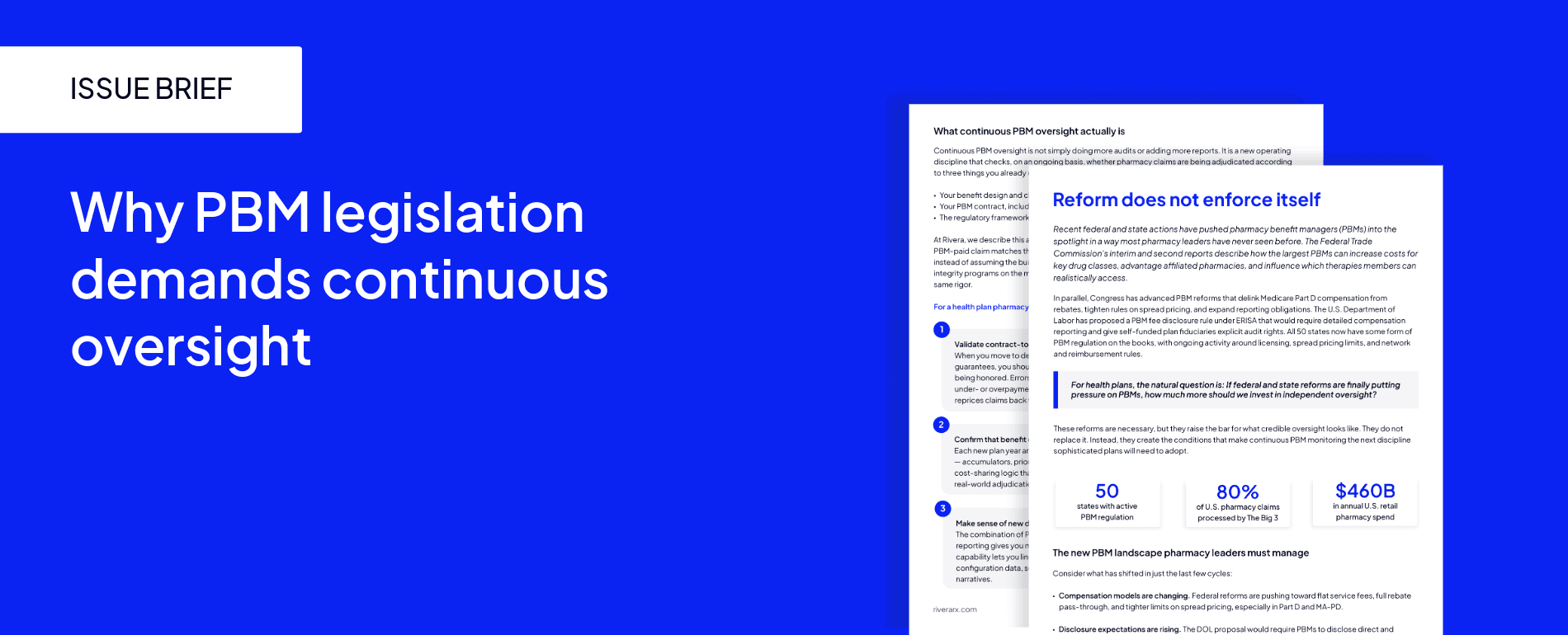
Reform does not enforce itself: Why PBM legislation demands continuous oversight
Reform does not enforce itself
Recent federal and state actions have pushed pharmacy benefit managers (PBMs) into the spotlight in a way most pharmacy leaders have never seen before. The Federal Trade Commission's interim and second reports describe how the largest PBMs can increase costs for key drug classes, advantage affiliated pharmacies, and influence which therapies members can realistically access.
In parallel, Congress has advanced PBM reforms that delink Medicare Part D compensation from rebates, tighten rules on spread pricing, and expand reporting obligations. The U.S. Department of Labor has proposed a PBM fee disclosure rule under ERISA that would require detailed compensation reporting and give self-funded plan fiduciaries explicit audit rights. All 50 states now have some form of PBM regulation on the books, with ongoing activity around licensing, spread pricing limits, and network and reimbursement rules.
For health plans, the natural question is: If federal and state reforms are finally putting pressure on PBMs, how much more should we invest in independent oversight?
These reforms are necessary, but they raise the bar for what credible oversight looks like. They do not replace it. Instead, they create the conditions that make continuous PBM monitoring the next discipline sophisticated plans will need to adopt.
The new PBM landscape pharmacy leaders must manage
Consider what has shifted in just the last few cycles:
Compensation models are changing. Federal reforms are pushing toward flat service fees, full rebate pass-through, and tighter limits on spread pricing, especially in Part D and MA-PD.
Disclosure expectations are rising. The DOL proposal would require PBMs to disclose direct and indirect compensation streams and give fiduciaries audit rights to evaluate whether those arrangements are reasonable.
Regulatory and political focus is sustained, not episodic. FTC staff have signaled continued scrutiny of formulary design, specialty drug pricing, and vertically integrated PBM–payer–pharmacy entities.
State requirements are stacking. States continue to revisit PBM licensure, spread pricing bans, MAC requirements, pharmacy network rules, and plan design constraints, creating a layered set of expectations on top of federal rules.
Every one of those shifts has to be expressed in contracts, benefit designs, and configuration. On paper, the direction is favorable: more transparency, different incentives, stronger fiduciary tools. In practice, each round of reform creates another set of moving parts that has to be built correctly and then kept in sync across lines of business.
Why current oversight will feel increasingly out of step
Most health plans already have an oversight toolkit: you negotiate hard on contract terms, run implementation and annual benefit build reviews, use scorecards and operational dashboards, and commission retrospective audits to test guarantees and pricing.
Those tools are not broken. They are just built for a world where contract and regulatory change happens in discrete bursts, where checking "Are we generally on track?" a few times a year was sufficient, and where "we audit our PBM" satisfied plan leadership.
The environment has shifted. Three things are happening at once:
Benefit and contract change is becoming continuous. Federal reforms, state laws, and client demands are pushing more frequent re-cuts of pricing terms, guarantees, and program design.
Disclosure is shifting the burden back to plans. With new audit rights and data feeds, fiduciaries are expected not just to receive information but to do something with it.
Stakeholder questions are more pointed. Plan leadership, regulators, and large employer clients are now asking, "How do you know these new rules and terms are actually being applied correctly?" — not just, "Do you have a PBM audit?"
Traditional implementations, scorecards, and audits still answer important questions. However, they are not designed to give a real-time view of whether your benefit design is configured correctly as you roll out changes, whether new compensation and pricing terms are reflected accurately at the claim line, or whether state and federal rules are being applied as expected.
That is the gap continuous PBM oversight is meant to fill.
What continuous PBM oversight actually is
Continuous PBM oversight is not simply doing more audits or adding more reports. It is a new operating discipline that checks, on an ongoing basis, whether pharmacy claims are being adjudicated according to three things you already own:
Your benefit design and clinical intent
Your PBM contract, including new fee, pricing, and performance terms
The regulatory framework that applies across your lines of business
At Rivera, we describe this as pharmacy payment integrity: continuously checking whether each PBM-paid claim matches the benefit, the contract, and the configuration rules that should govern it — instead of assuming the build is right. This is not a new concept. Health plans have operated payment integrity programs on the medical benefit for years. It's time for pharmacy programs to implement the same rigor.
For a health plan pharmacy leader, this capability means being able to:
Validate contract-to-claim performance in production
When you move to delinked compensation, full rebate pass-through, or new specialty guarantees, you should not have to wait for a year-end audit to see whether those terms are being honored. Errors in a pass-through model accumulate across the year as many small under- or overpayments unless you are testing claims as they are paid. Continuous monitoring reprices claims back to contract and flags where results diverge from what was negotiated.
Confirm that benefit design is configured and maintained correctly
Each new plan year and each mid-year change introduces opportunities for configuration drift — accumulators, prior authorization rules, step edits, network constructs, and member cost-sharing logic that do not fully match intent. A continuous discipline tests whether real-world adjudication matches the benefit you believe you are running.
Make sense of new data and disclosure
The combination of Part D reforms, new employer disclosure expectations, and state reporting gives you more PBM data, but not necessarily more insight. A continuous oversight capability lets you line up PBM-reported performance with your own claims, eligibility, and configuration data, so you can answer "What is actually happening?" with numbers, not narratives.
Document a defensible oversight posture
As enforcement actions and litigation continue, plans that can show a clear record of issues detected, remediations, and structural fixes will be in a stronger position with leadership, regulators, and large clients than those relying solely on occasional audits and vendor attestations.
For a comprehensive operational guide to building this capability, including contract terms, governance cadences, and claim-level repricing methodology, see our practical playbook for health plan pharmacy leaders. For a comparison of how audits and continuous monitoring serve different but complementary functions, see Snapshots vs. streaming.
Importantly, this is not an adversarial exercise. Pharmacy payment integrity is about getting claims right — not clawing money back from pharmacies, members, or providers. When issues are caught and corrected, the result is alignment, not conflict.
Most pharmacy leaders have the intent. What they lack is scale. A team reviewing claims manually will always be working a sample, and systemic issues don't reliably surface in small data sets. Continuous oversight means running every claim, not a subset, against the full set of contract, configuration, and benefit rules. No team can do that with spreadsheets and annual audits. The discipline requires infrastructure that most pharmacy leaders don't have today.
Where Rivera fits
Rivera was built on the premise that pharmacy benefit oversight would have to move from episodic, sample-based checks to continuous, claim-level monitoring, and we help you create it without rebuilding your entire oversight function.
In practical terms, Rivera gives health plans three main advantages in the current environment:
A live view of contract and benefit performance
Rivera continuously reprices pharmacy claims against contract and benefit rules, highlighting where new terms around pass-through, fees, or specialty reimbursement are not being applied the way you expect.
A single cross-product oversight lens
As Medicare, commercial, Medicaid, and self-funded lines of business experience different mixes of federal and state PBM rules, Rivera normalizes claim-level findings so you can see patterns and address issues once, rather than in siloed projects.
Evidence for stakeholders who now expect more
Plan leadership, regulators, and employer clients will not be satisfied with "We have a PBM audit." They will want to see trend lines, financial impact, and corrective actions. Rivera's continuous monitoring produces those proof points — recoveries, corrected claims, configuration fixes, and pattern changes — that demonstrate active stewardship of pharmacy dollars.
Looking ahead
The latest FTC reports, federal PBM reforms, and the DOL's PBM fee disclosure proposal are not the end of PBM oversight debates. They are the beginning of a new phase in how pharmacy benefits are governed, priced, and monitored.
Reform has moved the conversation from whether PBMs should be more transparent to how that transparency is implemented and verified. It has raised expectations that plans will understand their pharmacy dollars at the claim, contract, and policy level, and be able to show their work.
The question for health plan pharmacy leaders is not whether continuous oversight is a nice idea for some future state. It is whether you can credibly meet your fiduciary, regulatory, and business obligations without beginning to build this discipline now.
Plans that treat reform as a reason to ease up on oversight will still be accountable for every dollar that runs through their pharmacy benefit. Plans that use this moment to stand up a continuous, independent monitoring capability will be able to demonstrate something stronger than compliance — that they turned reform into measurable value for members and sponsors.
In practice, that starts with a clear-eyed look at where your current oversight has gaps. Not just in audit frequency, but in how quickly you can detect when a new contract term, benefit change, or regulatory requirement is not being applied correctly at the claim level. The plans that can answer that question with evidence, not assumptions, are the ones operating from a position of strength.
Those are the plans that will be ready for whatever comes next.
Download the PDF → Reform does not enforce itself
Get in touch

Follow us
Copyright
2026 Rivera, Inc.